
Fabulous Peltoncast No. 6

First, some big news: we have a logo!Peltoncast logo

After discussing that, in this week’s jam-packed Peltoncast your hosts discuss Kevin’s computer (and its Knicks projection) becoming a news story, talk about Seahawks pessimism and the team’s third-down issues, preview their Thursday night visit to Arizona, relate the feeling of helplessness created by Marcus Mariota, grade the Huskies at the midpoint of their season, study the meaning of their penalty woes (see below), make this week’s NFL’s picks, recap last week’s special Gameday tailgate and finish up by comparing the Kansas City defense to the ’85 Bears in terms of fantasy value.

DOWNLOAD/STREAM THIS WEEK’S PELTONCAST | Find on iTunes

INTRO: Kevin’s famous computer
9:00 Seahawks: are people too worried about a 5-1 team? Plus investigating third-down issues and looking ahead to Thursday’s game at Arizona (listen to the Seahawks section)
24:00 Huskies: recapping Saturday’s loss to Oregon, midseason grades, penalty study (listen to the Huskies section)
42:00 NFL picks
45:00 Tailgating: Getting up early for Gameday and cream cheese takes our tailgate to the next level (listen to the tailgating section)
54:00 Fantasy – A friendly wager on this weekend’s Peltoncast showdown and comparing the Chiefs defense to the ’85 Bears

This Week’s Links

– Explaining SCHOENE’s prediction for the Knicks
New York Post: “Knicks scoff at computer’s 37-win prediction”
Why Kobe ranks so low in #NBArank
– Kevin on the Mix-Minus Podcast
– Jerry Brewer on the Seahawks’ issues and high expectations
– Football Outsiders FEI Ratings

2013 NCAA Penalty Research

In the analysis of the first half of the Huskies’ season, we discuss the role of penalties. Washington has been called for the second-most penalties per game in the nation and leads all FBS teams in penalty yardage.

The research with which I’m familiar on penalties and team success has been conducted in the NFL. In Pro Football Prospectus 2007, Aaron Schatz and Bill Barnwell found that  a small negative correlation (-0.31) between offensive penalties and wins (that is, teams with more penalties perform worse) but little relationship between defensive penalties and wins.

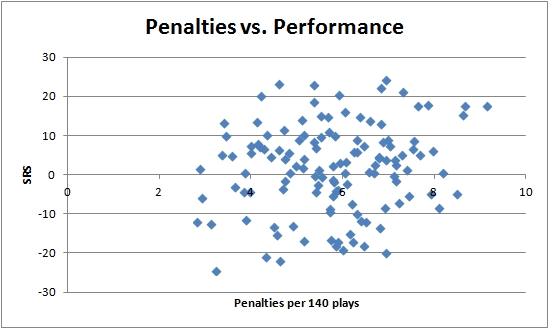
Using data from Sports-Reference.com, I quickly studied the relationship between penalties and yardage — both adjusted per 140 team plays on offense and defense to mitigate the effect of fast-paced offenses like UW’s that lead to more plays per game — and success and found a slightly positive correlation (0.15) between both and Sports-Reference.com’s Simple Rating for each team. Here’s how that looks graphically:
131016_penalties

Note that the three teams in the country that have been penalized most frequently — UCLA (9.1 per 140 plays), Florida (8.7) and UW (8.6) are all top-20 teams. But really, the data from this limited sample show very little relationship between penalties and team success in the NCAA this season.

In case you were curious, despite the reputation for overofficiating (and the Bruins and the Huskies drawing laundry by the load), the Pac-12 doesn’t lead the nation in penalties per 140 plays (including non-conference games). That honor actually belongs to the new American Athletic Conference:

Conference Pen/G   Yd/G   Pen140 Yd140
--------------------------------------
American    6.9    58.8    6.8    58.5
Sun Belt    6.6    54.4    6.5    53.3
Pac-12      6.8    57.8    6.3    53.5
Big 12      6.4    56.4    6.1    53.1
ACC         5.8    47.2    5.8    47.1
SEC         5.6    45.3    5.8    46.5
MAC         5.6    49.5    5.6    49.4
CUSA        5.5    45.8    5.4    44.9
Big Ten     5.5    48.1    5.4    47.2
MWC         5.3    50.0    4.8    45.9

Average     5.9    50.4    5.8    49.1

Blame Arizona State: The Huskies’ opponent on Saturday is at the opposite end of the spectrum, committing 3.4 penalties per 140 plays, the nation’s seventh-lowest average. So if you see a flag during the game, assume it will go against Washington.
Posted in peltoncast | Comments Off on Fabulous Peltoncast No. 6

Bishop Sankey Chasing Husky History

Through five games of the 2013 season, Washington running back Bishop Sankey is putting together one of the best performances ever by a rusher for the Huskies. On Saturday, Sankey rushed for 125 yards in a loss at Stanford, becoming the first running back to crack the century mark against the Cardinal this season and pushing his season total to 732 yards. That ranks second to Napoleon Kaufman (1994) for the most yards by a Washington running back through five weeks:

Player             Year  Yards   YPG
-------------------------------------
Napoleon Kaufman   1994   924   184.8
BISHOP SANKEY      2013   732   146.4
Greg Lewis         1990   644   128.8
Chris Polk         2011   611   122.2
Napoleon Kaufman   1993   575   115.0
Joe Steele         1978   568   113.6
Hugh McElhenny     1950   557   111.4
Rashaan Shehee     1997   541   108.2
Ron Rowland        1976   526   105.2
Corey Dillon       1996   503   100.6

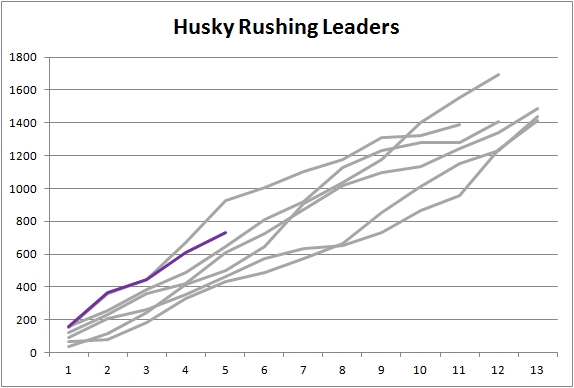
The single-season record Sankey is chasing (1,695 yards, or 141.3 per game) actually belongs to the last player on this list — Corey Dillon, who rushed for nearly 1,200 yards over the final seven games of his single season in a Husky uniform. Here’s how Sankey’s current pace (purple) compares to Dillon (the top line) and Kaufman (the line highest on the life) and the other top-six single season rushing performances in Washington history.

rushing_leaders_5

As long as Sankey keeps putting up big numbers — and he faces another defense this Saturday, Oregon, that hasn’t allowed a 100-yard rusher — we’ll update his pace on a weekly basis as he chases Husky history.

Posted in huskyfb, sankey chase | Comments Off on Bishop Sankey Chasing Husky History

Fabulous Peltoncast No. 5

Since the inaugural Peltoncast, Seattle sports (at least football) had been riding high. Not anymore. In similar games — both featuring controversial replay reviews — both the Huskies and Seahawks fell from the ranks of the unbeaten last weekend in difficult road games. Kevin and Tristan recap those games, plus look ahead to Oregon Week and a visit by the Tennessee Titans using advanced stats to scout both opponents. Later, they compare their top five tailgating condiments. Also, remembering Vladimir Radmanovic‘s Sonics career as he heads to retirement, the NFL pick of the week, fantasy football advice.

Download/Listen to the Fabulous Peltoncast No. 5 | iTunes

This week’s contents:

Intro: Remembering Vladimir Radmanovic‘s Sonics career
6:30: Recapping Husky/Seahawks losses, plus thoughts on refereeing (and Land Clark)
18:00: Previewing the Huskies vs. Oregon (Listen to just the Husky portion)
28:00: Previewing the Seahawks vs. Titans, plus Sidney Rice‘s poor catch rate (Listen to just the Seahawks portion)
43:00: Tailgating and ranking our top five tailgating condiments (Listen to just the tailgating portion)
49:00: Fantasy analysis

This week’s links:
Vladimir Radmanovic’s 8 3-pointer game against the Lakers (YouTube)
– Vlade sings the praises of a nice, warm fleece blanket (YouTube)
– Football Outsiders FEI and S+ P rankings
ESPN Stats & Info QBR rankings
– Football Outsiders DVOA and Catch Rate for WRs
– FoodSpin’s condiment rankings

Posted in peltoncast | Comments Off on Fabulous Peltoncast No. 5

Fabulous Peltoncast No. 4

The Fabulous Peltoncast is back and improved with a new theme song (“Slick Watts” by the Blue Scholars). This week’s episode features extending discussions of the Seahawks’ comeback win at Houston and the Washington Huskies’ win over Arizona, plus previews of this weekend’s games at Indianapolis and Stanford, respectively. Kevin and Tristan also recap a rainy afternoon of tailgating and take a look at fantasy football quarterbacks.

DOWNLOAD/LISTEN HERE | iTunes Feed

Also new this week, we’ve split out the main topics into individual audio files if you don’t want to listen to the whole thing:

Intro (A little Philadelphia 76ers talk, plus why we’re pushing our Nothing Was the Same discussion until next week)
Huskies (Highlights from Saturday’s win, plus how UW matches up with Stanford and a reader question on how noise affects no-huddle offenses)
Seahawks (Sunday’s comeback, a look ahead at the Colts plus Bruce Irvin’s return and Tristan takes Kevin to task)
Tailgating (Update on last week’s Coors Light debate poll)
Fantasy football (This week’s waiver claims, plus a look at top QBs)

This week’s links:

Tony Wroten is the ‘star of the day’
Jeff Sagarin‘s college football ratings
Seattle Times on Travis Coon’s excellent game

Posted in peltoncast | Comments Off on Fabulous Peltoncast No. 4

The Coors Light Debate Poll

During the most recent Fabulous Peltoncast, Tristan and I debated the merits of Coors Light. After hearing our positions, it’s time to get yours: Who won the debate?

[polldaddy poll=7431534]

Posted in Uncategorized | 3 Comments

Fabulous Peltoncast No. 3

In this week’s edition of the Fabulous Peltoncast, we discuss the Huskies and Seahawks combining for their largest margin of victory on the same weekend ever, a Sounders draw at L.A., preview the Seahawks’ big game at Houston this weekend, debate the merits of Coors Light and look at this week’s options on the fantasy football waiver wire.

DOWNLOAD/LISTEN HERE

The Fabulous Peltoncast is also now on iTunes! Download it to your devices and listen on the go.

This week’s topics:
3:00 Huskies/Seahawks combined blowouts and UW recap/preview
9:30 Seahawks vs. Jaguars recap
17:30 Seahawks at Texans preview
29:00 Coors Light debate and fall beer reviews
37:30 Fantasy football

Biggest combined margin of victory

The Huskies (56-0) and Seahawks (45-17) combined to win by 84 points this weekend. Previously, the largest combined margin Tristan found was the Huskies beating Kansas State 56-3 and the Seahawks beating Indianapolis 31-3 for a combined 81-point margin on Sept. 28 and 29, 1991. Alas, that still falls short of UW’s 120-point margin in a 120-0 win over Whitman on Oct. 25, 1919.

This week’s links:
The Game wearing a Shawn Kemp jersey before punching Brandon Jennings
Larry Stone on how losing to Arizona caused Steve Sarkisian to adapt an up-tempo offense
Seahawks-Jaguars box score on pro-football-reference
Football Outsiders playoff odds
NFL rushing leaders through three games

Posted in peltoncast | Comments Off on Fabulous Peltoncast No. 3

Fabulous Peltoncast No. 2

In the second edition of the Fabulous Peltoncast, Kevin and Tristan are back to discuss what might have been one of the best sports weekends in Seattle sports history, with wins by the Sounders, Husky football (and the Storm) and the Seahawks on consecutive days. Also, an update on tailgating and the all-important move to fall beers and fantasy football discussion.

LISTEN HERE

3:00 Sounders beat RSL
5:30 Huskies beat Illinois
11:30 Seahawks beat 49ers
25:30 Best Seattle sports weekend ever?
30:30 Tailgating/fall beers
37:30 Fantasy Football

Links

Grantland’s fall TV comedy preview
Seattle Times on Sounders depth
ESPN’s Heisman Watch
Pro-Football-Reference box score
Football Outsiders snap counts
Robert Mays on the Seahawks being the NFL’s coolest team

Bishop Sankey

Here are some of the stats on UW running back Bishop Sankey I discuss during the podcast. Over the last seven games, dating back to last year’s Cal game, Sankey has rushed for 1,142 yards. That figure would rank 10th in Washington history for a single season.

Two Huskies have had better seven-game stretches. Napoleon Kaufman rushed for 1,224 yards over the last two weeks of 1993 and the first five of 1994 and Corey Dillon had 1,192 over the final seven games of 1996, including the Holiday Bowl.

If we take Sankey’s last 13 games (the equivalent of a full season) dating back to the Portland State game in 2012, he’s rushed for 1,726 yards, which would be surpass Dillon’s 1996 campaign (1,695) for the most in Washington history — albeit in 13 games instead of the 12-game season Dillon played.

Lastly, Sankey has totaled 369 yards in the first two games. Besides being the most in the NCAA on a per-game basis, as best I can tell it’s the most ever for a Husky through two games to start the season. Kaufman had 363 yards in the first two games in 1994.

Posted in huskyfb, peltoncast | Comments Off on Fabulous Peltoncast No. 2

The Inaugural Fabulous Peltoncast

Welcome to The Fabulous Peltoncast, a podcast covering Seattle sports, tailgating, fantasy football, pop culture and whatever comes to mind hosted by your humble blogger and my brother, Tristan.

In this week’s inaugural episode, we look back on the Seahawks’ victory over Carolina and ahead to this weekend’s matchup with San Francisco, talk about a big weekend in Seattle sports — including Washington traveling to Chicago to take on an Illinois team that looked surprisingly spry last Saturday, talk about tailgating for the Seahawks-49ers game and wrap it up with some observations from the first week of the Two Hundred Sickness fantasy league.

Stream or download this week’s podcast here.

If you want to skip around, here are this week’s segments:
2:30 Seahawks recap/look ahead
18:30 Seattle sports weekend/Huskies at Illinois
25:00 tailgating
38:00 fantasy football

Links referenced in this week’s Peltoncast:

Pro-Football-Reference.com Seahawks-Panthers box score
Field Gulls on the read option
Field Gulls on Sherman Effect
Bill Barnwell on the Chip Kelly Offense
Football Outsiders on Illinois-Washington
Ju(i)cy Lucy Wikipedia page

Posted in peltoncast | Comments Off on The Inaugural Fabulous Peltoncast

Welcoming Back the Seahawks’ Third-Down Weapon

On a day where the Seattle Seahawks could never get their run going in Carolina — at least not until the final clock-killing drive — third downs loomed larger than usual. And nobody was better at converting with possession on the line than slot receiver Doug Baldwin. Quarterback Russell Wilson looked Baldwin’s direction four times on Sunday and came up with completions and first downs all four, including a tiptoe catch along the sideline on a ball Wilson appeared to be throwing away.

Not only was Baldwin the Seahawks’ best option on third down — Wilson completed just two other third-down throws for first downs, one apiece to starting wideouts Sidney Rice and Golden Tate — his four catches good for first downs were tied for fourth in the NFL this weekend.

Such third-down heroics are nothing new for Baldwin. As a rookie in 2011, playing primarily with Tarvaris Jackson, the undrafted Baldwin was one of the league’s most productive players on third down, catching 25 passes (tied for seventh in the NFL) for 23 first downs (fourth). Here’s how Baldwin compared to the NFL’s other third down leaders:

Player             T    C   FD    C%     FD%   FD/C   Y/T
---------------------------------------------------------
Roddy White       52   35   29   .673   .558   .829   8.4
Nate Washington   45   29   20   .644   .444   .690   8.0
Antonio Brown     44   28   25   .636   .568   .893   9.9
Victor Cruz       39   27   22   .692   .564   .815  17.9
Wes Welker        44   26   24   .591   .545   .923   7.3
Davone Bess       42   26   13   .619   .310   .500   5.9
Doug Baldwin      42   25   23   .595   .548   .920   9.7
Darren Sproles    32   25   12   .781   .375   .480   7.0
Austin Collie     45   23   22   .511   .489   .957   6.2
Steve Johnson     40   23   15   .575   .375   .652   8.1

Baldwin’s performance on third downs was nearly identical to fellow undersized, undrafted Wes Welker. As compared to the other most frequent third-down targets, Welker and Baldwin (and Austin Collie) were most efficient at turning their completions into first downs more than 90 percent of the time. The only difference? Baldwin also mixed in enough yards after catch to rank third in yards per target. (Related: Victor Cruz, whoa!)

Such play convinced Football Outsiders to rank Baldwin No. 1 on their list of top 25 “prospects” (young players without starting experience or elite draft pedigree) entering last season. But while the rest of the Seahawks’ receiving core improved with Wilson replacing Jackson under center, Baldwin wasn’t nearly as effective during a sophomore campaign that was plagued by injury. He came up with just eight first downs on 13 completions among the 23 passes Wilson threw him on third down.

Over such a small sample, Baldwin’s decline on third down could have been nothing but noise; he came up a yard short of the sticks three times, and turning those plays into first downs would have been enough to make him a much more effective player. However, Baldwin got worse across every down; his DVOA (Football Outsiders’ measure of per-play effectiveness) dropped from 14.2 percent better than average and tops among the team’s receives to right at league average and far worse than Rice and Tate.

On the “Fifth Quarter” postgame show, Baldwin provided an alternative explanation, pointing out that the hamstring injury that sidelined him during training camp prevented him from getting needed work with Wilson. Indeed, this year’s Football Outsiders Almanac notes that Baldwin got better as the 2012 season went on.

Now healthy and with the benefit of a full camp with Wilson, Baldwin appears to have the timing he needs to be a factor on third downs. That’s a big addition to what was already a potent Seahawks passing attack.

Pro-Football-Reference.com’s Play Index was invaluable in calculating these stats.

Posted in seahawks | Comments Off on Welcoming Back the Seahawks’ Third-Down Weapon

What Gonzaga’s Loss Doesn’t Tell Us

When the Gonzaga Bulldogs were eliminated from the NCAA tournament by the Wichita State Shockers last night, I was annoyed. In part, I was frustrated that my bracket was busted — I had Gonzaga reaching the Final Four — but the larger concern was how the Zags’ early exit validated criticisms of their No. 1 seed that I don’t find accurate.

On Selection Sunday, Kenpom.com ranked Gonzaga 4th in the country — exactly the same place the selection committee put the Bulldogs as the last No. 1 seed. Doubters might contend that this is a product of beating up on their weak conference schedule, and naturally ratings that don’t consider margin of victory had the Zags somewhat lower. They were sixth, for example, in RPI. However, there’s not exactly a history of Pomeroy and company overrating Gonzaga. Before this year, the last time the Zags lost to a lower-rated team in the NCAA tournament was 2004, when they were upset by Nevada in a 2-7 matchup. And the last time Gonzaga was this good, 2006, Kenpom.com seemed to underrate the Bulldogs, who finished 41st after losing to Final Four-bound UCLA in a Sweet 16 heartbreaker.

The legitimate criticism of Gonzaga’s No. 1 seed is that the team never was tested against other elite teams. In fact, Kenpom.com now ranks Wichita State as the best team the Bulldogs played all season. But that would be a more plausible explanation if Gonzaga’s tournament run came to an end at the hands of a top-10 foes. The Shockers are rated similarly to many of the tournament-bound teams the Zags did face, including Kansas State (a 4 seed), Oklahoma State (5) Illinois (7) and St. Mary’s (11).

Of course, Gonzaga lost at home to Illinois and at Butler. But when we break down the Bulldogs’ pre-tournament performance by quality of opponent, it becomes clear that their schedule had little to do with their rating. To do so, I switched to Sports-Reference.com’s Simple Rating System. (I don’t have rankings from before the tournament, but I believe SRS had Gonzaga fifth, behind the three three No. 1 seeds and Duke.) Using opponent ranking and adjusting for location, we can come up with how the Zags’ actual scoring differential in any game compared to expectation for an average team. Here’s how that works out against different groups of opponents:

Split                        SRS
--------------------------------
Total rating                20.9
WCC opponents               22.0
Tournament opponents        21.8
Non-WCC Tourney opponents   19.4

Yes, Gonzaga was at its best in conference play, but the Zags were almost equally good against teams that made the NCAA tournament. In part, that reflects how well Gonzaga played in three matchups against a quality St. Mary’s team (an average of +26.5 in three games, which would make the Zags the best team in the country). Even when you take the Gaels out, Gonzaga’s rating against tournament-bound foes is still commensurate with a top-10 team. Basically, there was nothing from the Bulldogs’ regular season that suggested they would struggle like they did during the NCAA tournament.

And struggle Gonzaga did. The Zags’ ratings from their games in Salt Lake City — +3.5 points above average against No. 16 Southern, and +8.2 points above average in the loss to Wichita State — were two of their four worst performances all season, along with the loss to the Illini and a two-point escape at San Diego in WCC play.

Why Gonzaga played so poorly in the NCAA tournament is a different issue. Was the no. 1 seed too much pressure, especially after an unexpected opening-round scare? Was it nothing more than 3-point defense/luck? I’m not sure. But I do know that what happened in Salt Lake City doesn’t disprove that the Zags were one of the nation’s best teams this season.

Posted in ncaambb | 5 Comments